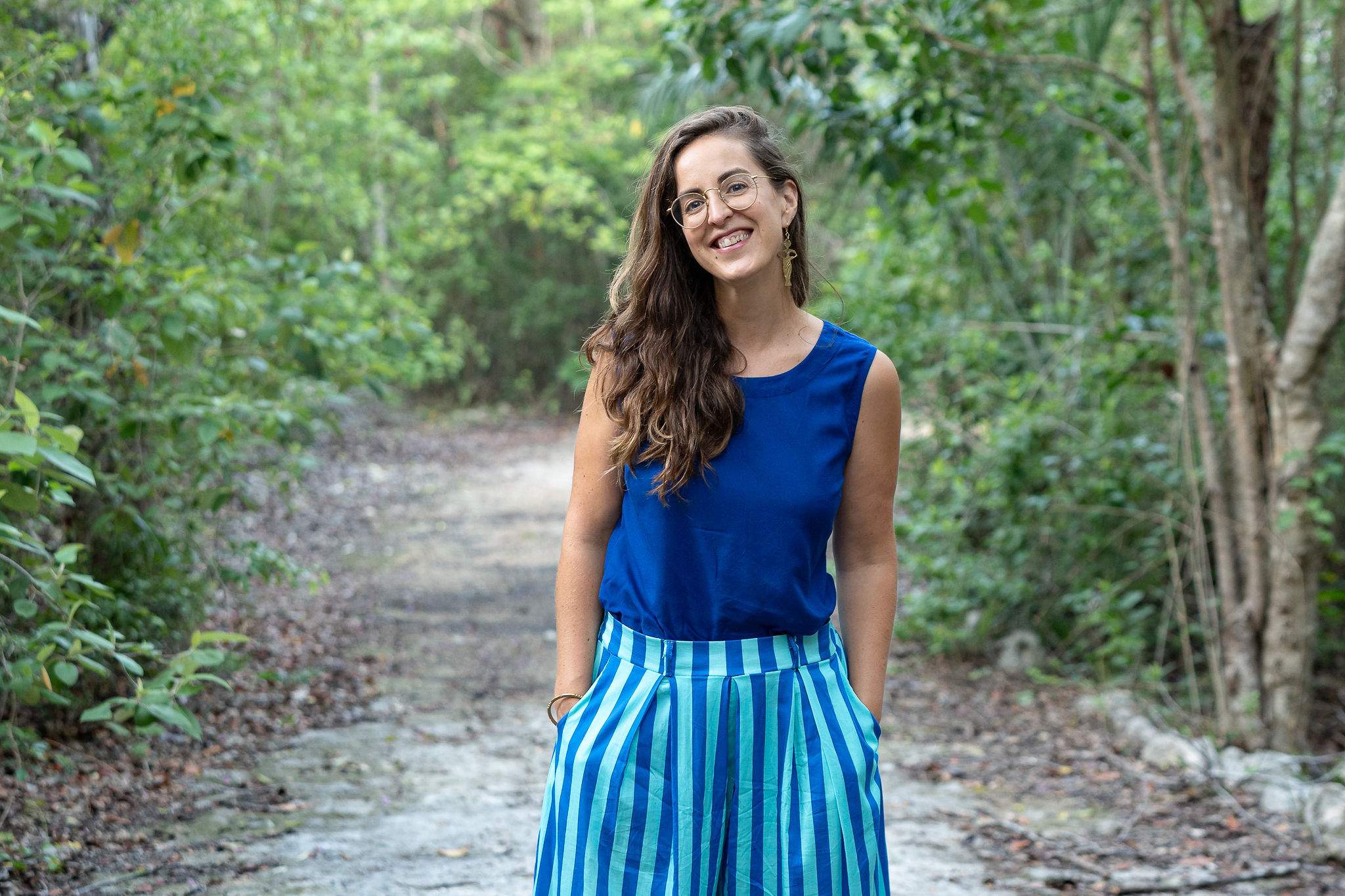

Biography
Delphine Lévi Alvarès has spent her career building movements to uproot parts of the fossil economy. She came to it through waste and plastic pollution, connecting people and organizations worldwide to strategize and campaign towards zero waste and toxic-free societies together. Over the past decade, that work led her to the source of the problem: the petrochemical industry that manufactures it in the first place.
Delphine grew up in the French Alps. “I spent a lot of time hiking in the mountains with my parents,” she recalls. That time outdoors, she says, “forged within me a strong relationship with the invisible forces of nature and a lively imagination and capacity to dream.”
Delphine’s career began in the most visible part of the planetary crises caused by the fossil economy: literal garbage. Her first job was campaigning against incineration and landfilling in her home country. That work led her to helping launch the Zero Waste movement in France and contributed to what was then the country’s most ambitious circular-economy legislation to prevent waste at source and keep products and materials in use rather than discarded.
When France hosted the UN’s COP21 climate summit in 2015, Delphine’s preparatory work with the international networks GAIA and Zero Waste Europe prompted her to scale up her efforts. She was instrumental in forming the new global Break Free From Plastic movement, and building its European wing through Zero Waste Europe. In 2017, within that movement she co-founded the Rethink Plastic Alliance, a Brussels-based coalition to champion ambitious EU plastics policy. Among their wins was the EU’s Single-Use Plastics Directive, which banned many common single-use plastic items and introduced new polluter-pay mechanisms. Passed into law in 2019, it is to date one of the fastest pieces of environmental legislation approved in the EU.
“I’m an optimist and a dreamer, and I enjoy bringing people together and supporting them to be the best they can be collectively and deliver work that is more than the sum of their individual contributions,” she says.
As international climate and zero waste movements evolved and coalesced, Delphine’s focus shifted upstream. Along with movement partners at the Center for International Environmental Law, which she joined in 2023, she widened the work to include other critical fossil-based chemicals, in particular agrochemicals, and elevated the non-energy uses of fossil fuels with the climate movement.
Describing herself as someone who leads from the heart with vulnerability, Delphine says she tries to focus on finding ways to achieve the greatest impact without sacrificing joy or care.
“Always pursue what makes you smile,” is advice Delphine received long ago and one she has passed on herself to people on her own path.
Breakthrough program
Delphine Lévi Alvarès was selected for the Climate Breakthrough Award program in 2026.
Petrochemicals are the chemicals derived from oil, gas, and coal that get turned into plastics, fertilizers, pesticides, synthetic textiles, and thousands of other everyday products. They are, quite literally, everywhere in modern life—the packaging on our food, the fibers in our clothes, the dashboard of our car, the components of our mobile phones—so woven into daily existence that most people do not notice them.
The way they hide in plain sight, says Delphine, is what makes them dangerous. As the rapid transition to clean energy erodes the fossil fuel industry’s traditional markets, Delphine calls petrochemicals “the lifeline for the industry’s financiers.” The sector could drive up to half of oil demand growth by mid-century, and already accounts for 14 percent of global oil consumption, 8 percent of gas, and 10 percent of global greenhouse gas emissions.
Despite a growing number of organizations touching this issue, no one has pulled that work into a unified global effort. Filling that gap is what Delphine plans to pursue through the Climate Breakthrough Award program.
Delphine measures success collectively, not individually. “A successful collective implementation of a jointly nurtured vision across movements and constituencies for how the world could look in a fossil-free economy will help bring back freedom and power to people and communities,” she says.
Delphine’s plan centers on three connected threads. First, she envisions a tool that maps, by region, sector, and material, the multiple pathways out of a petrochemical economy. She will build it collaboratively with other partners in the movement, and the tool is intended for use by decision-makers, investors, advocates, and others. Second, she’ll expand her efforts to convene the civil society groups, movement members, and frontline communities already working on pieces of this problem separately. Third, she aims to build and spread a vivid new vision of what a world without petrochemical dependence looks like—unnecessary plastics eliminated, everyday materials that no longer put our health at risk, and industries that no longer trade away sustainability for short-term convenience.
Unlike the shift away from using fossil fuels for energy, where the alternatives are already visible and readily deployable, no comparable picture of a post-petrochemical world yet exists. That future “is yet to be dreamed into reality,” as Delphine puts it.