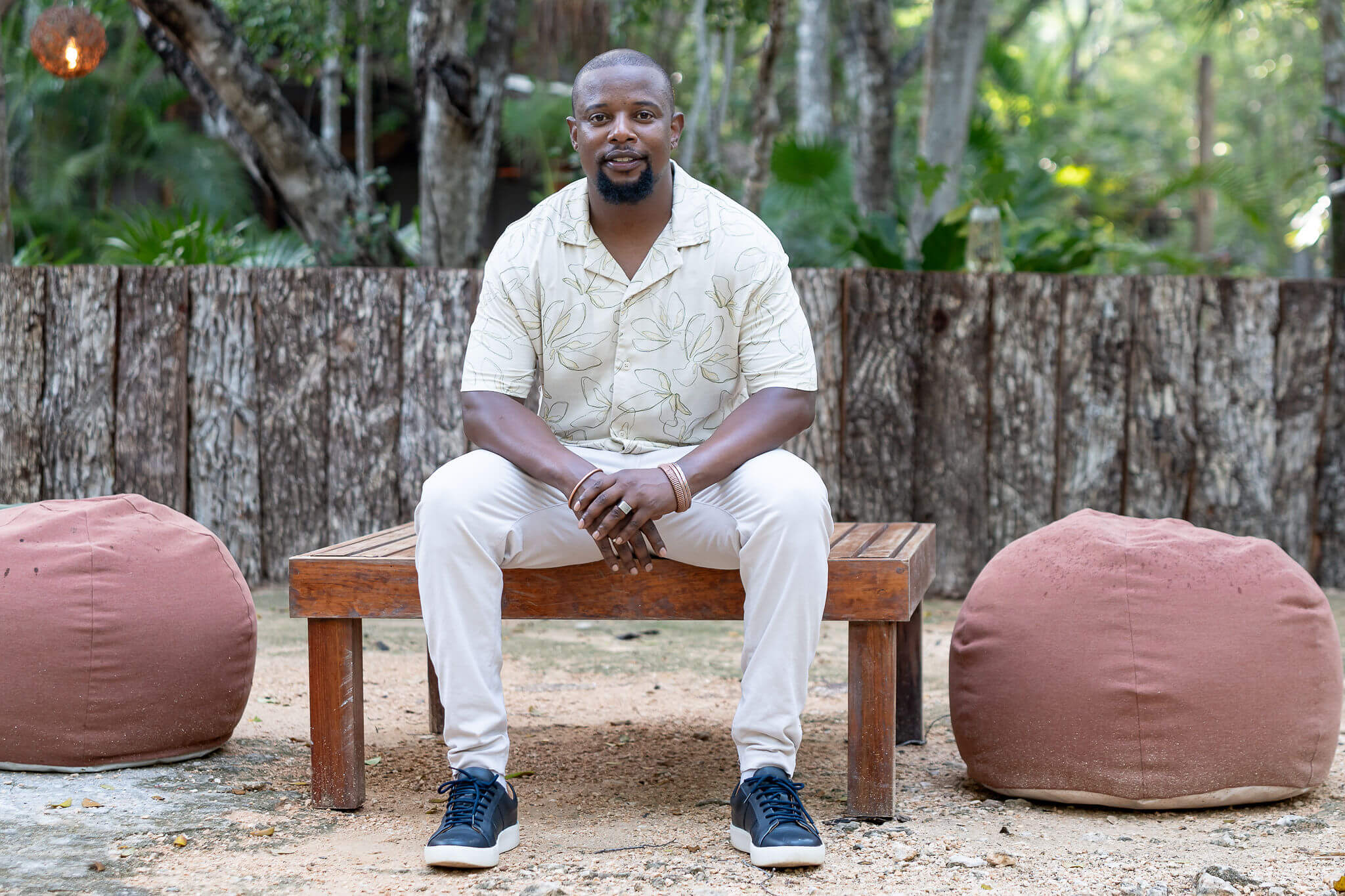

Biography
Nyasha Frank Mpahlo has spent more than a decade building formidable community power in Zimbabwe—first against corruption, now against energy poverty. He’s poised to take his community-first model for the energy transition across the whole continent of Africa.
Nyasha’s childhood was spent in a mining town, where he worked in small-scale artisanal mining to supplement his family’s income. His mother instilled values he still carries, captured in a rule: “If everyone is doing something wrong, let it not be you. And if only one person is doing something good, let it be you.”
He built his early career at Transparency International Zimbabwe, leading anti-corruption movement-building and advocacy. He then became Regional Coordinator for an organization focused on campaigns for transparency and good governance, leading a network of organizers across the region. That work made him a target. In 2019 he was arrested alongside several colleagues and falsely charged with subverting a constitutional government. Domestic and international pressure from his network helped secure his release, and the charges were later dropped in 2020.
Around this same period, Nyasha’s focus was shifting toward climate change. He founded Green Governance Zimbabwe to advance community-centered climate action by building out programs on energy governance, youth engagement, gender justice, and urban food systems. Over the past few years, he’s grown the organization into Green Governance Africa (GGA), expanding into neighboring Southern African countries.
The clearest expression of Nyasha’s approach is GGA’s “Green Villages” model that combines local renewable energy, agroecology (farming methods that work with natural ecosystems), sustainable water management and fuel-efficient cookstoves into a single, community-led package. Through GGA’s work in villages across Zimbabwe, Zambia, and Mozambique, hundreds of residents now practice agroecology, have access to clean cooking, and have been trained to harness and manage solar power.
“One of the exceptional traits I bring to my work is a strong inclination toward locally-led innovation and experimentation. I enjoy exploring new ways of doing things and challenging conventional approaches to problem-solving,” he says.
His own team reflects this; Green Governance Africa is staffed mostly by people under 35, whom he mentors as readily as he seeks out mentors himself.
Speaking on what drives his community-first model, he says that “everyone holds something dear to contribute to the betterment of this world, even in the smallest ways, and we should strive to find it and use it.”
Breakthrough program
Nyasha Frank Mpahlo was selected for the Climate Breakthrough Award program in 2026.
Africa is at a turning point. Around 600 million people still lack electricity, and roughly a billion cook with polluting fuels even as solar power scales rapidly across the continent. But weak grid infrastructure threatens to lock Africa into a gas power instead of renewables. The continent also holds a striking share of the minerals the energy transition depends on, and more than 350 million young people there will enter the workforce over the next decade, half of them projected to be without jobs under current trends. Together, these forces risk making the energy transition Africa’s next resource curse, where resource-rich countries end up poorer and less stable because of who controls the extraction and who profits from it.
Nyasha’s stance is that Africa’s energy problem is not only a technology problem but a fit-for-purpose problem. Much of the investment poured into climate solutions on the continent has gone toward importing technologies developed elsewhere, and those technologies often fail. Take clean cookstoves as an example; they avoid the health harms and emissions of traditional wood-burning stoves, but they don’t provide the heat, light, or gathering space a hearth does. The Green Villages model, he says, is proof that community-led design produces relevant and context-specific technology that local people keep using, rather than technology that gets abandoned.
Through the Climate Breakthrough Award program, Nyasha wants to build what he calls the Energy+ Innovators Platform. It’s a continent-wide hub connecting African energy innovators—people building hundreds of home-grown energy solutions rooted in local knowledge. The platform would help them learn from one another and collaborate. Its scope would span far more than electricity, from water management, food systems, and agriculture to transportation, health, and renewables. He wants to pair this hub with blended finance models—a mix of funding sources like grants and loans designed to make otherwise-risky projects investable—that can sustain enterprises past their pilot stage.
What Nyasha really wants to measure is not projects built or electricity generated. Instead, it’s whether people’s lives actually change: access to energy, food, and clean water; better health; new livelihoods. That means working at two levels at once: building breakthrough community by community, while also identifying and dismantling the policy barriers that keep good solutions from scaling regionally.