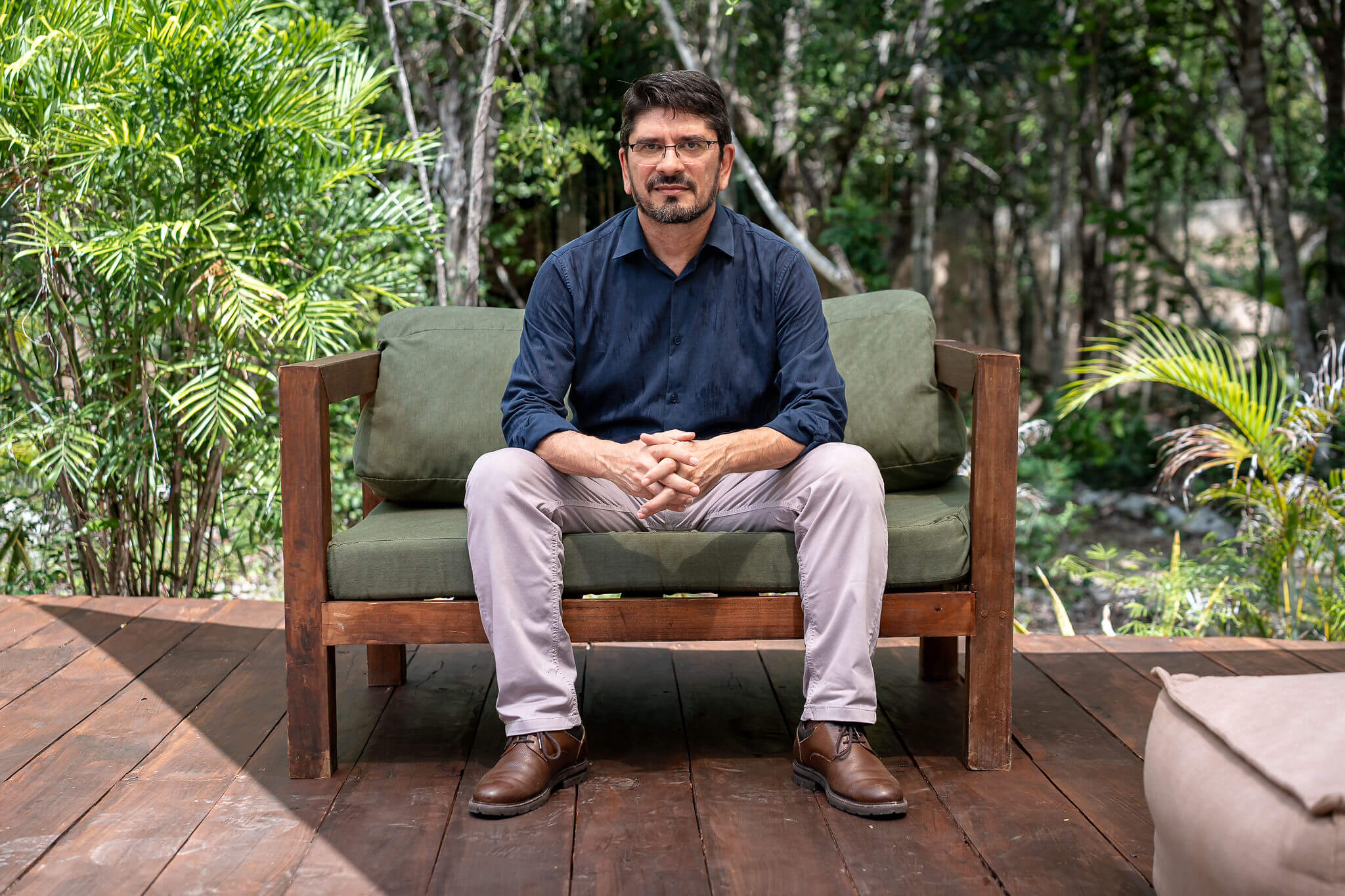

Biography
Valmir Ortega has never been afraid to dream bigger; it’s almost a calling. A serial social entrepreneur, he has spent more than two decades building the policies, institutions, and businesses needed to end deforestation. His work rests on a powerful inversion: the tropical farmland that ranks among the planet’s largest sources of emissions is also, handled differently, its greatest untapped carbon sink. Turning that liability into an asset has been his life’s work in Brazil, and now he’s ready to bring that model across the tropics.
Valmir grew up in a small town in the interior of Brazil. As a child, he witnessed what he calls “an enormous transformation of both the landscape and the social fabric” as the country urbanized and modernized its agriculture at the cost of vast environmental liabilities. It left him with a lasting sense of contradiction.
“I saw up close the great paradox of my country,” Valmir says. “One of the planet’s foremost environmental powers is, at the same time, one of its largest emitters from land use.”
Drawn to understand the transformation he had witnessed firsthand, Valmir studied geography at university and began his career as a professor with the intention of continuing in research. But in 1999 his path shifted decisively when he joined Brazil’s public sector as Superintendent of Environment in Mato Grosso do Sul. That work led him to the Brazilian Institute of Environment and Renewable Natural Resources (IBAMA) and later to the frontline of Amazon deforestation as State Secretary of Environment in Pará. It was there, in 2008, that he pioneered the Rural Environmental Registry (known by its Portuguese acronym CAR), a policy that became national law four years later and remains one of Brazil’s most powerful tools for monitoring and controlling deforestation on private land.
After 15 years in government, Valmir moved into the NGO sector as Senior Director of Policy at Conservation International Brazil, before turning to social entrepreneurship in earnest. He founded Conexsus in 2018 to connect rural and forest businesses with finance and markets.
In 2020, Valmir founded Belterra to build scalable models for regenerating Brazil’s more than 80 million hectares of degraded pasture land. Belterra has since grown into three interlinked organizations—Belterra Agroflorestas, Rio Capim Agrossilvipastoril, and Instituto Belterra—operating across four Brazilian states and three biomes (the Amazon, Atlantic Rainforest, and Cerrado). This work has drawn increasing recognition, including selection in 2024 for the inaugural cohort of the Rockefeller Foundation’s Big Bets Fellowship and recognition in 2025 as Social Entrepreneur of the Year by the Schwab Foundation at the World Economic Forum.
Valmir points to his ability to move between worlds that rarely understand one another—public policy, private finance, and grassroots organizing—as his greatest asset, along with an instinct for turning problems into the seeds of their own solutions, and a track record of building institutions to carry them.
“It is this combination—translator between worlds, reframer of problems, and builder of institutions—that allows me to confront a challenge that is systemic, not merely technical.”
Breakthrough program
Valmir Ortega was selected for the Climate Breakthrough Award program in 2026.
Land use and agriculture account for roughly 75 percent of Brazil’s emissions, while food systems contribute approximately one-third of global emissions. Tropical forests store more than half of the world’s above-ground carbon, but 95 percent of forest loss happens in the tropics—almost all driven by agriculture—and evidence suggests that these ecosystems are nearing a tipping point.
Valmir argues that the challenge is not a lack of proven techniques for regenerating degraded tropical land. What’s missing is the operational and financial infrastructure to bring them to landscape scale rather than isolated pilots.
The proof is already on the ground in Brazil. Belterra’s agroforestry arm partners with small and medium-sized farms across four states, helping them grow crops like cacao, cassava, and bananas using methods that regenerate soil instead of depleting it. Its ranching arm, Rio Capim, has shown that mixing trees into cattle pastures can increase how many cattle each hectare supports, freeing the rest to grow back as forest. Its community-facing arm, Instituto Belterra, channels support to Indigenous communities, Quilombola communities, and others whose work protecting land does not fit conventional financing models.
Valmir calls the missing piece “Tropical Climate Infrastructure,” which he will build through the Climate Breakthrough Award program. The idea is to organize landscapes around a central hub, connected to a ring of surrounding producers and a supporting financial ecosystem. Essentially, it is Belterra’s model at a far larger radius. The goal is to make sustainable land use the economically dominant way to farm, not merely a technically proven alternative.
Valmir wants to establish these hubs first in Brazil, then extend the same model into Central America, Africa, and Southeast Asia. Transforming agricultural practices and preserving carbon sinks could potentially influence hundreds of millions of hectares of land across the Global South. In the long term, he estimates this work could reach gigaton-scale removal (billions of tons of CO2 per year) by 2040.
“The most important outcome, however, is not a successful company,” Valmir underscores. “It is a replicable paradigm; proof that the tropics can lead the global climate solution, led by those who produce and live in them.”